

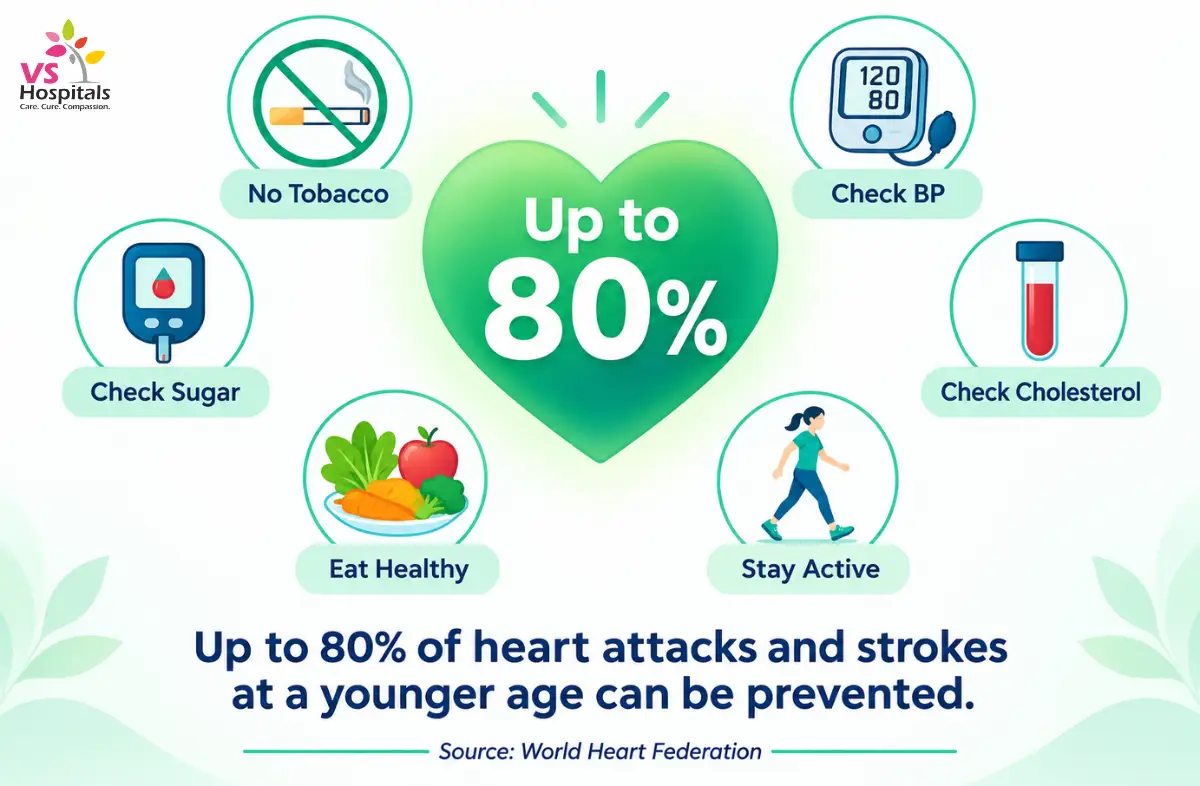
When you or someone you love has a heart problem, you want clear answers and care you can count on. The good news is that much of heart disease can be prevented. The World Heart Federation says up to 80% of heart attacks and strokes that happen at a younger age can be prevented by managing risk factors such as blood pressure, sugar, cholesterol and tobacco use. Choosing a heart hospital is a big decision, and it can feel hard when you are worried. This guide keeps things simple. It shows the cardiac care listed at VS Hospitals, Chennai, explains the warning signs that need emergency help, and tells you what to look for in any heart hospital, so you can decide with confidence.
Heart Care at VS Hospitals, Chennai
VS Hospitals is a multispeciality hospital in Chennai with branches at Chetpet, Kilpauk and Tondiarpet. The hospital lists the following for heart care:
- Cardiac consultation: Heart health check ups and advice from heart specialists.
- Emergency cardiac care: Care for heart attack patients, available 24/7.
- Cardiac surgery: Surgery such as bypass surgery and heart valve surgery.
- Preventive care: Heart disease prevention programs and lifestyle advice.
- Rehabilitation: Support to help you recover and return to daily life after heart treatment.
- Facilities: The hospital lists cath labs, 3D imaging and hybrid operating rooms for diagnosis and treatment.
The hospital’s aim is to look after you from the first check up through treatment and recovery. Heart doctors and surgeons work with other teams, such as radiology, anesthesia, intensive care and dietitians, so your care is planned together. To see the doctors, visit the VS Hospitals doctors page. Services and doctors can differ by branch, so please confirm what is available at the time of your visit.
Why Does the Hospital You Choose Matter for Heart Problems?
For many heart problems, time matters. In a heart attack, a blocked artery cuts off blood to the heart muscle. The sooner the blockage is treated, the more heart muscle can be saved. That is why emergency care, tests and treatment should be available at one place, at any hour. For problems that are not urgent, such as high blood pressure, heart rhythm changes or valve problems, a good hospital helps by finding the cause early and explaining your options clearly.
When Should You Go to a Heart Hospital?
See a heart specialist if you have:
- Chest pain, pressure or tightness, especially with activity
- Breathlessness that is new or getting worse
- A fast, pounding or uneven heartbeat
- Dizziness or fainting
- Swollen feet or ankles with tiredness
- High blood pressure, diabetes, high cholesterol or a family history of heart disease and you have not had a check up
Call an ambulance (108 or 112) right away if you have chest pressure or pain lasting more than a few minutes, pain spreading to the arm, neck, jaw or back, cold sweat, nausea, severe breathlessness or fainting. Do not drive yourself, and do not wait to see if the pain passes. Women may feel back or jaw pain, nausea or unusual tiredness instead of crushing chest pain. For more help, read our guide on chest pain at night.
What Should You Look For in a Heart Hospital?
Whichever hospital you choose, check these points:
- Emergency care at any hour: A team ready for heart attacks, with tests and treatment available quickly.
- Heart doctors and surgeons in one hospital: So you do not lose time moving between places.
- Heart tests in one place: ECG, echo, stress tests and angiography.
- Intensive care: For patients after surgery or with serious conditions.
- Registered doctors: Check that doctors are registered with the National Medical Commission or a State Medical Council.
- Clear explanation: The team should explain your diagnosis, options, risks and likely cost in simple words.
- Insurance and scheme support: Ask which plans and schemes are accepted.
- Rehabilitation and follow up: Recovery does not end when you leave the operation theatre.
Do not choose a hospital only because of ads or ranking lists. Ask questions, and take a second opinion if you are unsure.
What Tests are Used to Check the Heart?
Your doctor will ask about your symptoms and check your heart and blood pressure. You may then need some of these tests. You will not need all of them.
- ECG: Records the electrical activity of the heart.
- Echocardiogram: An ultrasound that shows how the heart pumps and how the valves work.
- Blood tests: Check cholesterol, sugar and signs of heart muscle damage.
- Stress test: Checks how the heart behaves during exercise.
- CT scan or angiography: Shows the heart arteries and any blockages.
- Holter monitor: Records the heartbeat over a day or more.
What Treatments Are Used for Heart Problems?
Treatment depends on your condition and overall health. Many heart problems are first managed with medicines and lifestyle changes. Other options your doctor may advise include:
- Angioplasty and stent: A thin tube with a tiny balloon opens a blocked artery, and a small mesh tube called a stent keeps it open.
- Bypass surgery (CABG): The surgeon uses a blood vessel from another part of the body to make a new path around a blocked artery.
- Heart valve repair or replacement: Treats valves that are too tight or that leak.
- Pacemaker: A small device placed under the skin that helps a slow or uneven heartbeat.
- Minimally invasive heart surgery: Surgery through smaller cuts, which is suitable only for some patients.
- Advanced care for severe heart failure: In rare cases, doctors may talk about a heart pump or a transplant.
Your heart team will explain which option fits you, and the risks and benefits of each.
What Can You Expect as a Patient?
- Meet the specialist: You talk about your symptoms, medicines and family history.
- Tests: The tests you need are arranged and explained.
- Results and plan: The doctor explains what was found and the options in simple words.
- Estimate and insurance: You can ask for an estimate and ask about insurance before you decide.
- Treatment: Medicines, a procedure or surgery, if needed.
- Recovery: Diet advice, rehabilitation and follow up visits.
How Can You Lower Your Risk of Heart Disease?
- Do not smoke or chew tobacco
- Check your blood pressure, sugar and cholesterol regularly
- Eat more vegetables, fruits and whole grains, and less salt and fried food
- Be active for about 30 minutes on most days
- Keep a healthy weight
- Limit alcohol and manage stress
- Take your medicines as advised, and go for regular check ups
Plan Your Visit
If you have heart symptoms, risk factors or a family history, a check up can give you clarity and peace of mind. VS Hospitals lists the following branches:
- Chetpet: 13, E Spur Tank Rd, Chetpet, Chennai 600031
- Kilpauk: 815/306, Poonamallee High Rd, Kilpauk, Chennai 600010
- Tondiarpet: 58, 60, No. 3, Surya Narayana Chetty St, 8th Block, Nagoor Garden, Tondiarpet, Chennai 600081
Please bring old reports, ECGs, a list of your medicines, a photo ID and your insurance card if you have one. In an emergency, do not wait for an appointment. Go to the nearest emergency room.
Conclusion
The right heart hospital is one where emergency care is ready, the team is registered and explains things clearly, and tests, treatment and recovery are planned together. If you have warning signs, call for emergency help without delay. If you have risk factors or symptoms that keep coming back, do not wait to get checked. At VS Hospitals, Chennai, heart care includes consultation, emergency care, surgery, prevention and rehabilitation.