


Knowing your breasts is one of the simplest and most useful things you can do for your health. It takes only a few minutes, costs nothing and helps you feel more in control. There is reassuring news too. Most breast lumps and changes are not cancer. And when breast cancer is found early, while it is still only in the breast, treatment works very well. The American Cancer Society reports a 99% five year relative survival rate for breast cancer found at this early stage. This means women with early breast cancer are about as likely to be alive five years later as women without it. A home check cannot prevent or diagnose breast cancer, but it helps you notice a change early and get it checked quickly. This guide shows you how to check breast cancer at home in simple steps, what is normal, which changes need a doctor, and what to do if you find something.
What Does Checking Your Breasts at Home Mean?
A home check, also called a breast self exam, means looking at and feeling your breasts to learn what is normal for you. Doctors are not all of one mind on whether a strict monthly routine is needed. Many health groups now stress “breast awareness”, which means knowing your breasts and reporting any new change quickly. Whichever way you prefer, a home check is free, takes a few minutes and helps you act early. It does not replace a breast exam by a doctor or a mammogram.
What is Normal for Your Breasts?
Breasts are not perfectly even, and they change over time. These things are usually normal:
- One breast is slightly bigger or lower than the other
- Lumpy or ropy tissue, which is common, especially near the armpit
- Tenderness, swelling or lumpiness before your period
- Changes during pregnancy and breastfeeding
- Softer, less dense breasts after menopause
After a breast surgery, biopsy or radiation, you may have scar tissue. Learn your new normal once you have healed.
When is the Best Time to Check?
If you still have periods, check a few days after your period ends, when breasts are less swollen and tender. If you no longer have periods, pick an easy date, such as the first of the month. Checking about once a month is a common habit. A full check takes about 5 to 10 minutes.
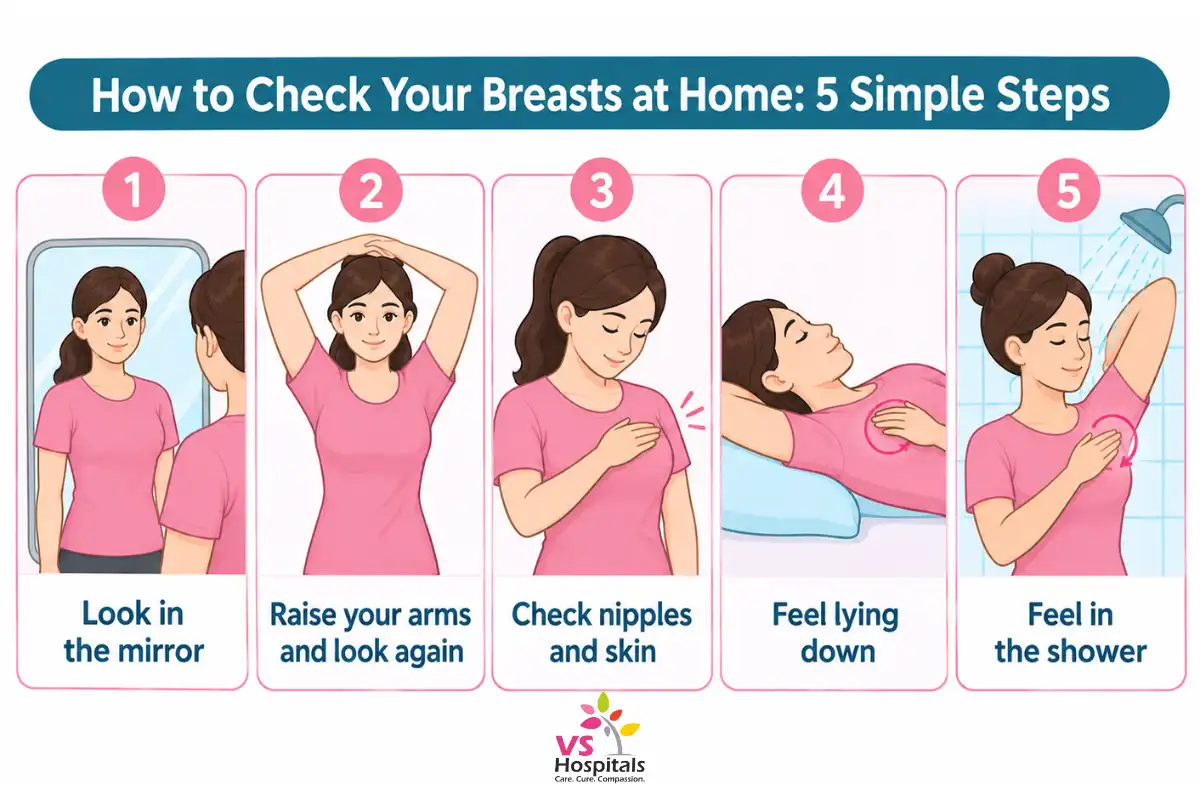
How to Check Breast Cancer at Home: 5 Steps
Step 1: Look in the mirror with your arms down
Stand in good light with your shoulders straight and arms at your sides. Look at the size, shape and color of both breasts. Look for swelling, dimpling or puckering of the skin, or a nipple that has changed direction or turned inwards.
Step 2: Raise your arms and press your hands on your hips
Lift your arms above your head and look for the same changes. Then place your hands on your hips and press firmly to tighten your chest muscles, and look again. Redness can be harder to see on brown or black skin, so also watch for changes in the texture and shape of the skin and breast.
Step 3: Look at your nipples and skin
Check for a rash, scaling, sores or fluid coming from the nipple on its own. You do not need to squeeze your nipples. If you see fluid, especially blood or fluid from one side only, tell a doctor.
Step 4: Feel your breasts lying down
Lie on your back with a pillow under your right shoulder and your right arm behind your head. Use the pads of your three middle fingers of your left hand, keeping them flat. Press in small circles about the size of a coin. Use light pressure for the skin, medium pressure for the middle and firm pressure for the deep tissue near the ribs. Cover the whole area, from your collarbone down to the bra line and from your armpit to the breastbone. Use a pattern, such as up and down rows, so that you do not miss any part. Then repeat on the other side.
Step 5: Feel your breasts in the shower or while standing
Wet, soapy skin helps your fingers glide. Use the same circles and pressure while standing, and gently feel under each armpit for lumps or swelling.
What If You Have Breast Implants?
You can still check your breasts at home if you have implants. Ask your surgeon to show you where the edges of your implant are, so you know what is the implant and what is your own breast tissue. When you check, press firmly around the edge of the implant until you can feel the ribs underneath. Also look for any change in the shape of the breast, new pain, swelling or hardness around the implant. If you go for a mammogram, tell the technician that you have implants before the test starts.
Which Breast Changes Need a Doctor?
See a doctor if you notice any of these:
- A new lump or thickened area in the breast or armpit
- A change in the size or shape of a breast
- Dimpling, puckering, redness or skin that looks like an orange peel
- A nipple that is newly inverted, or a rash or sore on the nipple
- Nipple fluid other than breast milk, especially bloody fluid
- Swelling in the armpit or near the collarbone
- Pain in one spot that does not go away
Most of these changes are not cancer, but only a doctor can tell the cause.
What Should You Do If You Find a Lump?
First, stay calm. Most breast lumps are not cancer. Common causes are cysts, harmless growths and hormone changes.
- See a doctor soon, without waiting, if the lump is hard, does not move, is growing, or comes with skin or nipple changes or bloody discharge.
- For other changes, if you still have periods, check again after your period. If the change is still there, see a doctor.
At the visit, the doctor will ask about your health, examine your breasts and may suggest imaging. An ultrasound is often used first for younger women, and for women who are pregnant or breastfeeding. An ultrasound and a mammogram are often used for women over 30. If needed, you may have a biopsy, where a tiny sample of tissue is checked in a lab. If you are unsure about the advice, you can ask for a second opinion.
Self Exam, Doctor Exam and Mammogram: What Is the Difference?
| Home check | Doctor’s breast exam | Mammogram | |
|---|---|---|---|
| Who does it | You | A doctor or trained nurse | A trained technician, read by a doctor |
| What it does | Helps you learn what is normal | Checks for lumps and other changes | An X ray that can find changes too small to feel |
| How often | About once a month, or as you prefer | As advised by your doctor | As advised, based on age and risk |
| Can it replace the others | No | No | No |
All three work best together.
Mistakes to Avoid
- Relying on a home check alone and skipping medical screening
- Pressing or squeezing too hard, which can cause pain and false alarms
- Panicking, or searching the internet for hours instead of seeing a doctor
- Waiting for many weeks to see if a worrying change goes away
- Feeling fully safe after one normal check
Who Should Be Extra Careful?
Talk to your doctor about earlier or extra screening if you have a close relative with breast or ovarian cancer, a known BRCA gene change, earlier radiation to the chest, or a past breast condition such as atypia. Men, and transgender people with breast tissue, can get breast cancer too, and should report any lump or change.
Screening Beyond Home Checks
Screening means checking for cancer before you have symptoms. In India, the national programme for non communicable diseases advises a clinical breast exam once every five years for all women aged 30 to 65. This is offered at government health centres such as Ayushman Arogya Mandirs. Many doctors also advise a mammogram from around age 40 to 45, depending on your risk. If you have a family history or other risk factors, you may need to start earlier or have checks more often. Ask your doctor what suits you. You can learn more in our guide to cancer screening tests for women and our guide on the causes of cancer.
When Should You See a Specialist?
If you notice a new lump, a skin or nipple change, or discharge, please do not wait to see if it goes away. Our doctors can examine you, explain what the change may mean and arrange the right tests, such as an ultrasound or a mammogram, if needed. You can also see us for a routine breast exam, or to plan your screening based on your age and family history.
When you come for your visit, please bring:
- Any old scan or biopsy reports
- A list of the medicines you take
- Details of any family history of breast or ovarian cancer
- The date of your last period, if you still have periods
Most breast changes turn out to be harmless. Getting checked early gives you clear answers and peace of mind.
Conclusion
Learning how to check breast cancer at home helps you know your breasts and notice changes early. It is quick and free, but it is only one part of breast care. Combine it with regular doctor exams and screening, and do not delay seeing a doctor if you find a new lump, a skin change or nipple discharge.
This article is for general information and awareness only. It is not a substitute for medical advice, diagnosis or treatment. Please consult a qualified doctor for your specific condition.