



Digestive problems can be uncomfortable, and they can also be confusing. Do you need a gastroenterologist, a liver specialist or a surgeon? How do you know the doctor you pick is the right one? This guide answers these questions in simple words. It introduces the gastroenterology doctors at VS Hospitals, Chennai, explains who treats what, lists the tests you may hear about, and gives clear tips for choosing a gastroenterologist in India with confidence.
Gastroenterologists at VS Hospitals, Chennai
Dr. Chandra Mohan
Senior Gastroenterologist, VS Hospitals (Tondiarpet)
Dr. Chandra Mohan is a medical gastroenterologist who treats a wide range of stomach, bowel and liver problems. He trained at Tamil Nadu Dr. M.G.R. Medical University and holds a DM in Gastroenterology, an MD in Paediatrics and a Diploma in Child Health (DCH). Because he is trained in both child health and gastroenterology, he can provide digestive care for children as well as adults. His approach includes clear diagnosis, patient education and long term planning for chronic digestive conditions.
View Dr. Chandra Mohan’s profile
Dr. J. Saravanan
Senior Consultant Surgical Gastroenterologist, Advanced Laparoscopic Surgeon and GI Onco Surgeon, VS Hospitals (Kilpauk)
Dr. J. Saravanan is a surgeon who operates on the digestive organs, mainly the liver, pancreas, bile ducts and bowel. He completed his MBBS at JIPMER, Pondicherry, his MS in Surgery at Stanley Medical College and Hospital, and his MCh in Surgical Gastroenterology at the Institute of Surgical Gastroenterology and Liver Transplant. He also holds fellowships in advanced laparoscopic (keyhole) surgery, including F.MAS, FALS in HPB, colorectal and hernia surgery, and FIAGES.
His areas of interest include:
- Liver and pancreas surgery: For example, removing part of the liver for liver cancer, and the Whipple procedure, an operation to remove part of the pancreas and nearby organs, mainly for tumors in the head of the pancreas.
- Keyhole surgery: For colon cancer, hernia repair, gastric ulcer and removal of the spleen.
- Laser treatment: For fistula, piles and pilonidal sinus.
View Dr. J. Saravanan’s profile
The doctor you need depends on your problem. Your first visit will help sort this out. Doctors and services can differ by branch, so please confirm availability before you visit.
What Does a Gastroenterologist Treat?
A gastroenterologist treats diseases of the digestive system. This includes the food pipe, stomach, small and large intestines, liver, gallbladder, bile ducts and pancreas. Common problems include:
- Acid reflux (GERD) and stomach ulcers
- Irritable bowel syndrome (IBS)
- Crohn’s disease and ulcerative colitis (inflammatory bowel disease)
- Fatty liver, hepatitis and cirrhosis
- Gallstones and pancreatitis
- Constipation, diarrhea and food intolerance, including celiac disease
- Polyps and cancers of the digestive system, along with surgeons and cancer specialists
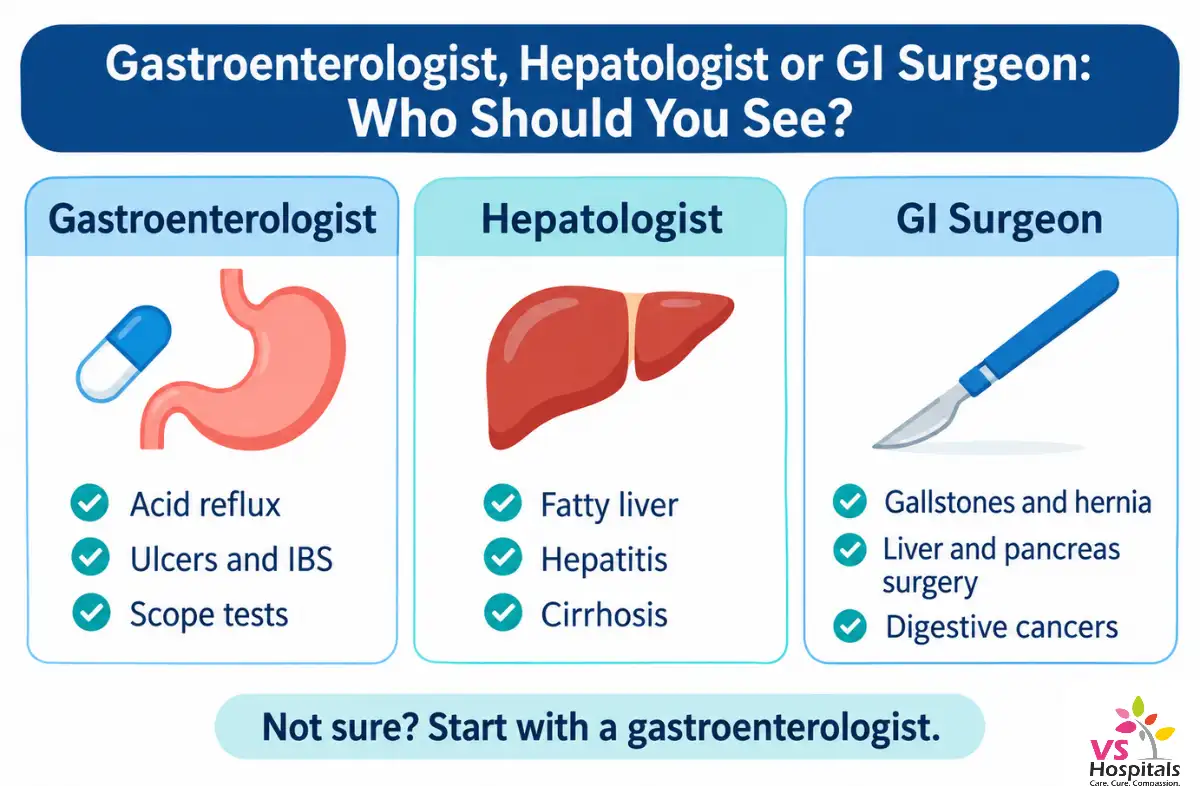
Gastroenterologist, Hepatologist or GI Surgeon: Who Should You See?
| Specialist | Who they are | Common reasons to see them |
|---|---|---|
| Gastroenterologist | A physician with extra training in digestive diseases, such as a DM in Gastroenterology | Acid reflux, ulcers, IBS, bowel disease, scope tests, polyp removal |
| Hepatologist | A gastroenterologist who focuses on the liver | Fatty liver, hepatitis, cirrhosis |
| GI surgeon (surgical gastroenterologist) | A surgeon with an MCh in Surgical Gastroenterology | Gallstones that need surgery, hernias, digestive cancers, liver and pancreas surgery |
Many people first see a gastroenterologist, who refers them to a surgeon if surgery is needed.
When Should You See a Gastroenterologist?
Make an appointment if you have:
- Belly pain that is strong, keeps coming back or lasts more than two to three weeks
- Heartburn or acid reflux that happens often
- Trouble swallowing
- Blood in the stool, or black stool
- A change in bowel habits lasting more than two to three weeks
- Weight loss without trying
- Yellow eyes or skin (jaundice)
- Abnormal liver test results
Go to an emergency room right away if you have severe or worsening belly pain, you vomit blood, you pass black, tarry stool or a lot of blood, or you feel faint with bleeding.
Tests and Procedures You May Hear About
- Upper endoscopy: A thin tube with a camera looks at the food pipe, stomach and the first part of the small intestine.
- Colonoscopy: A similar tube looks inside the large intestine and can remove small growths called polyps.
- ERCP: A scope passed through the mouth, with X rays, is used to treat problems in the bile and pancreas ducts, such as removing stones or placing a small tube called a stent.
- Endoscopic ultrasound (EUS): A scope with a tiny ultrasound probe looks closely at the pancreas, bile ducts and the wall of the digestive tract. It can also take small samples.
- Imaging tests and blood tests: Ultrasound, CT or MRI and blood tests help find the cause of symptoms and check how the liver is working.
- Keyhole (laparoscopic) surgery: An operation done through small cuts, used for problems such as hernias, gallstones and some cancers, when it is suitable.
Your doctor will choose only the tests that fit your symptoms. You will not need all of them.
How Do You Choose a Gastroenterologist in India?
Rankings and “top 10” lists can be confusing, and no list can tell you which doctor is right for you. These checks are more useful:
- Registration: Check that the doctor is registered with a State Medical Council or in the Indian Medical Register on the NMC website.
- The right kind of specialist: Match your problem with the right doctor, a gastroenterologist, a hepatologist or a surgeon.
- Qualifications: Look for recognised degrees, such as a DM in Gastroenterology or an MCh in Surgical Gastroenterology.
- Hospital support: Check for tests and scopes, an intensive care unit and emergency care in the same hospital.
- Clear talk: A good doctor explains the cause, the options and the risks in simple words, and does not mind a second opinion.
- Cost and insurance: Ask for an estimate and ask which insurance plans and schemes are accepted.
- Be careful with claims: Doubt any promise of a guaranteed cure or “success rate” in an advertisement.
What Happens at Your First Visit?
The doctor asks about your symptoms, food, medicines and family history, checks your belly and may advise tests. Bring your old reports, scans and a list of medicines. You will get a plan with the next steps and a time for follow up.
Plan Your Visit
- Dr. Chandra Mohan, Tondiarpet: Book a consultation. Address: 58, 60, No. 3, Surya Narayana Chetty St, 8th Block, Nagoor Garden, Tondiarpet, Chennai 600081.
- Dr. J. Saravanan, Kilpauk: Visit his profile page to book. Address: 815/306, Poonamallee High Rd, Kilpauk, Chennai 600010.
Please also bring a photo ID and your insurance card if you have one. In an emergency, do not wait for an appointment. Go to the nearest emergency room.
Conclusion
Choosing a gastroenterologist is easier when you know who treats what and what to check. Look for registered doctors, the right kind of specialist, clear explanations and hospital support. At VS Hospitals, Chennai, Dr. Chandra Mohan and Dr. J. Saravanan consult at the branches listed above. If your digestive symptoms last more than two to three weeks or come with warning signs, do not wait to get them checked.
This article is for general information and awareness only. It is not a substitute for medical advice, diagnosis or treatment. Please consult a qualified doctor for your specific condition.