




Stomach pain, acid reflux, loose motions and constipation are problems that most of us face at some point. Often they settle on their own. But when they persist, keep coming back or come with warning signs, it is time to see a gastroenterologist specialist in Chennai. This guide explains what a gastroenterologist does, which symptoms need a visit, what tests and treatments to expect, and which gastroenterologists consult at VS Hospitals. It is written to help you feel prepared and calm before your visit.
What is Gastroenterology?
Gastroenterology is the branch of medicine that deals with the digestive system. This is the long pathway that starts at your mouth and ends at the rectum. It includes the food pipe, stomach, small intestine, large intestine (colon) and rectum. It also covers the liver, gallbladder, bile ducts and pancreas, which help digest food, process nutrients and handle waste products and medicines.
A gastroenterologist studies how these organs work, finds out why they are not working well, and treats the problem.
Who is a Gastroenterologist?
A gastroenterologist is a doctor with special training in digestive and liver diseases. They find the cause of your symptoms with a check up and tests, and then treat the problem with medicines, diet advice or procedures.
Many people think a gastroenterologist never operates. That is only partly true. A medical gastroenterologist is a physician who treats digestive diseases, mainly with tests, scopes and medicines. A surgical gastroenterologist is a surgeon who operates on the digestive organs.
| Medical gastroenterologist | Surgical gastroenterologist | |
|---|---|---|
| Training | MD or DNB, then DM in Gastroenterology | MS in Surgery, then MCh in Surgical Gastroenterology |
| What they do | Find the cause with tests and scopes, and treat with medicines and endoscopic procedures | Operate on the digestive organs, including keyhole surgery |
| Common examples | Acid reflux, ulcers, IBS, liver disease, removing polyps | Surgery for the gallbladder, hernia, piles, colon, liver and pancreas |
Doctors who focus on the liver are sometimes called hepatologists. The right surgeon for a problem such as piles, a hernia or gallbladder stones depends on the condition and the hospital’s specialist team. Your doctor will tell you if you need to see a surgeon.
Gastroenterologists at VS Hospitals, Chennai
The doctors below are listed with their branch.
Dr. Chandra Mohan
Senior Gastroenterologist, VS Hospitals (Kilpauk and Tondiarpet)
Dr. Chandra Mohan is a gastroenterologist who treats a wide range of stomach, bowel and liver problems. He trained at Tamil Nadu Dr. M.G.R. Medical University and holds a DM in Gastroenterology, an MD in Paediatrics and a Diploma in Child Health (DCH). Because he is trained in both child health and gastroenterology, he can provide digestive care for children as well as adults.
View Dr. Chandra Mohan’s profile
Dr. J. Saravanan
Senior Consultant Surgical Gastroenterologist, Advanced Laparoscopic Surgeon and GI Onco Surgeon, VS Hospitals (Kilpauk)
Dr. J. Saravanan is a surgeon who operates on the digestive organs, including the liver, pancreas and bile ducts. His areas of interest include liver surgery, pancreas surgery, keyhole surgery for colon cancer, hernia and gastric ulcer, and laser treatment for fistula, piles and pilonidal sinus. He completed his MBBS at JIPMER, Pondicherry, his MS in Surgery at Stanley Medical College and Hospital, and his MCh in Surgical Gastroenterology at the Institute of Surgical Gastroenterology and Liver Transplant. He also holds fellowships in advanced laparoscopic surgery (F.MAS, FALS and FIAGES).
When Should You See a Gastroenterologist?
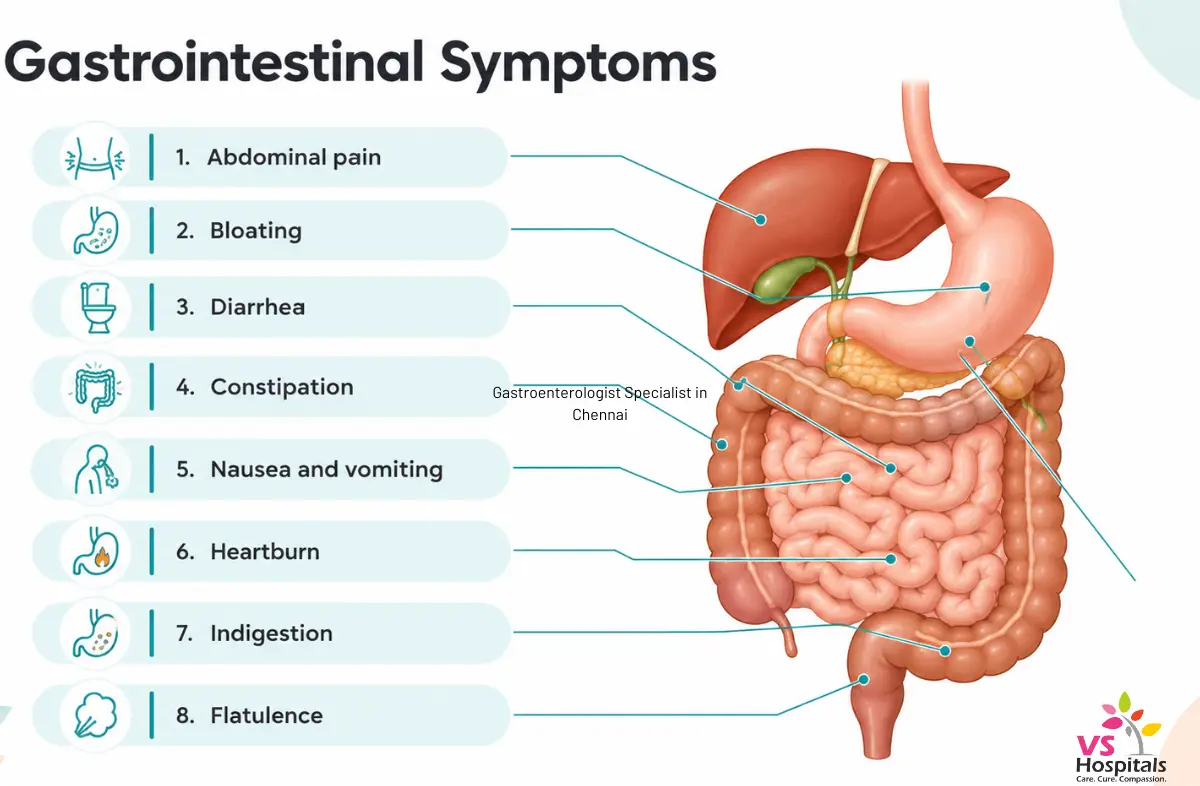
Make an appointment if you have any of these problems:
- Stomach pain that is strong, keeps coming back or lasts more than two to three weeks
- Heartburn or acid reflux that happens often or does not improve with simple measures
- Trouble swallowing, or food that feels stuck
- Blood in the stool, or black stool. Do not wait for weeks with this symptom.
- A change in bowel habits, such as new constipation or loose motions, lasting more than two to three weeks
- Weight loss without trying
- Bloating that does not go away
- Yellow eyes or skin (jaundice)
- Abnormal liver test results
- A family history of colon cancer, so you can ask about screening
Go to an emergency room right away if you have severe or worsening belly pain, you vomit blood, you pass black, tarry stool or a significant amount of blood in the stool, or you feel faint or very dizzy along with bleeding. Yellow skin or eyes with fever or belly pain also needs prompt medical care.
What Tests Might a Gastroenterologist Advise?
After asking about your symptoms and checking your belly, your doctor may suggest some of these tests. You will not need all of them.
- Blood and stool tests: They check for infection, anemia, liver problems and hidden blood.
- Imaging tests: Your doctor picks an ultrasound, CT or MRI based on your symptoms and the organ that needs to be checked.
- Upper endoscopy: A thin tube with a tiny camera is passed through the mouth to look at the food pipe, stomach and the first part of the small intestine.
- Colonoscopy: A similar tube is used to look inside the large intestine. The doctor can also remove small growths called polyps.
- Other scope tests: In some cases, doctors use tests such as endoscopic ultrasound, capsule endoscopy or ERCP to look at the pancreas, bile ducts or small intestine.
- Liver tests and assessments: Blood tests help assess liver-related markers and function. Ultrasound and special tests such as elastography may help evaluate fatty liver and liver stiffness.
Which Conditions Does a Gastroenterologist Treat?
- Acid reflux (GERD) and stomach ulcers
- Irritable bowel syndrome (IBS)
- Inflammatory bowel disease, such as Crohn’s disease and ulcerative colitis
- Fatty liver, hepatitis and cirrhosis
- Gallstones and pancreatitis
- Constipation, diarrhea and food intolerance, including celiac disease
- Piles, fissures and fistulas, which a gastroenterologist may evaluate but a surgeon may need to treat
- Polyps and cancers of the digestive system, along with cancer specialists
What Treatments are Used?
Treatment depends on the problem and your overall health. It may include:
- Diet and lifestyle changes: Simple changes in meals, weight, sleep and habits can help many digestive problems.
- Medicines: For acid, infections, bowel problems and liver conditions.
- Endoscopic procedures: For example, stopping bleeding, removing polyps or placing a stent, without a cut on the skin.
- Surgery: Some problems, such as gallstones, hernias, piles or digestive cancers, may need surgery. Many operations can be done by keyhole (laparoscopic) surgery, if it is suitable for you.
Why See a Gastroenterologist Early?
Many digestive problems start with mild symptoms. Seeing a specialist early can help you find the cause sooner, get the right treatment and avoid problems that can come with delay. Screening tests for colon cancer, such as a stool test or colonoscopy, can find problems before symptoms start. You can read more about screening in our guide on cancer screening tests for women.
How Can You Prepare for Your Visit?
A little preparation helps your doctor find the cause faster.
- Write down your symptoms and when they started
- Note anything that makes them better or worse, such as certain foods
- Bring old reports, scans and a list of all medicines you take
- Ask if you need to fast before any test
- Take a family member along if you would like support
How Can You Keep Your Digestive System Healthy?
- Eat meals at regular times, with plenty of fruits, vegetables, whole grains and fiber
- Drink enough water through the day
- Limit oily, spicy and processed food if they upset your stomach
- Stay active and keep a healthy weight
- Avoid tobacco and limit alcohol
- Do not take painkillers or antibiotics without advice, as they can upset the stomach
- Take care of your liver by following our tips on how to keep your liver healthy
Conclusion
Digestive problems are common and many can be treated well when they are checked early. If your symptoms last for more than two to three weeks, keep coming back or come with warning signs, do not wait. A gastroenterologist specialist in Chennai can find the cause and plan the right treatment for you. At VS Hospitals, Dr. Chandra Mohan and Dr. J. Saravanan consult at the branches listed above.
This article is for general information and awareness only. It is not a substitute for medical advice, diagnosis or treatment. Please consult a qualified doctor for your specific condition.