The Numbers That Should Alarm Every Indian
Before we talk about symptoms and treatment, look at these numbers. Every minute, three Indians suffer a stroke. Every year, over 18 lakh stroke cases are reported in India. Stroke is currently the third leading cause of death and the sixth leading cause of disability in our country. Globally, it is the second leading cause of death. And here is the most unsettling part — while developed nations have seen a 42% drop in stroke cases over recent decades, India has witnessed a 100% increase.
These are not just statistics. Each number is a family turned upside down overnight. The good news? Up to 80% of strokes are preventable — and the ones that do happen are highly treatable when caught fast enough.
Medically reviewed by
Dr. Sindhuja – 14+ years of experience
Senior Neurologist
MD (Pediatrics),DNB (Pediatrics),DM (Neurology),FEBN,MRCP-SCE(Neurology)
VS Hospitals, Chennai.
Last reviewed: May 25, 2026.
What Is Heat Stroke?
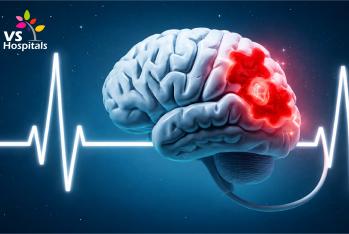
A brain stroke — also called a brain attack — happens when the blood supply to a part of your brain is suddenly interrupted. Without blood, brain cells are deprived of oxygen and nutrients, and they begin to die within minutes. The longer the blood supply remains cut off, the more severe and lasting the damage.
Think of it this way: a heart attack is a blocked artery in the heart. A brain stroke is a blocked or burst artery in the brain. The consequences depend entirely on which part of the brain is affected and how quickly treatment begins.
What happens during a brain stroke ?
A brain stroke happens when the blood supply to a part of the brain gets interrupted — either because a blood vessel gets blocked (ischemic stroke) or bursts (hemorrhagic stroke / brain hemorrhage). Without oxygen, brain cells begin to die within a few minutes. This is a medical emergency, and immediate medical attention is necessary.
The Three Types of Brain Stroke
Ischemic Stroke (the most common — 87% of all strokes) This occurs when a blood clot or fatty deposit blocks an artery supplying blood to the brain. It is the most treatable form, especially when caught within the golden window of 4.5 hours.
Hemorrhagic Stroke (Brain Hemorrhage) This occurs when a blood vessel in the brain ruptures and bleeds into the surrounding tissue. Brain hemorrhage searches have spiked 120% recently in India — and for good reason. While less common than ischemic stroke, it tends to be more severe and carries a higher mortality rate. Sudden, severe headache (“the worst headache of your life”) is a classic warning sign.
TIA — Transient Ischemic Attack (Mini Stroke) A TIA causes stroke-like symptoms that resolve within minutes to a few hours, leaving no permanent damage. Many people brush it off — this is a dangerous mistake. A TIA is your brain sending an urgent warning that a major stroke may be imminent. Take it seriously. See a neurologist the same day.
Brain Stroke Symptoms: The FAST Method
Recognising stroke symptoms early is the single most important thing a bystander can do. Use the globally trusted FAST test:
F — Face Drooping Ask the person to smile. Does one side of the face droop? Does the face look uneven or feel numb on one side?
A — Arm Weakness Ask them to raise both arms. Does one arm drift downward? Is there sudden weakness or numbness in one arm or leg?
S — Speech Difficulty Is their speech slurred, garbled, or impossible to understand? Are they unable to speak at all, or struggling to find words?
T — Time to Call Emergency If you notice any one of the above signs, call emergency services immediately. Do not drive yourself. Do not wait to “see if it gets better.” Time is brain.
Additional stroke symptoms to watch for:
- Sudden severe headache with no known cause (hallmark of brain hemorrhage)
- Sudden vision loss or double vision in one or both eyes
- Sudden dizziness, loss of balance, or difficulty walking
- Sudden confusion or trouble understanding what others are saying
Who Is at Risk? Understanding the Surge in India
Research from the Global Burden of Disease Study 2021 (published in Nature Scientific Reports) confirms that stroke incidence in India ranges from 119 to 145 per 100,000 population annually, with significantly higher rates in urban areas compared to rural regions. Key risk factors driving India’s stroke burden include:
Medical risk factors: Hypertension is the single biggest contributor. Uncontrolled blood pressure, diabetes, high cholesterol, obesity, and atrial fibrillation all dramatically increase stroke risk.
Lifestyle risk factors: Physical inactivity, smoking, excessive alcohol consumption, and high-sodium diets are all strongly linked. The shift toward sedentary, urban lifestyles is a major driver of India’s rising numbers.
Environmental risk factors: Air pollution — particularly in states like Bihar, Jharkhand, and Maharashtra — has been identified as a significant contributor to stroke mortality in India.
Age and family history: Risk increases significantly after age 55. A family history of stroke or heart disease raises your personal risk substantially.
Stroke Treatment: From Emergency to Recovery
Stroke treatment is a race against time. Every minute a large stroke goes untreated, approximately 1.9 million brain cells die. Here is how our neurology team at VS Hospitals approaches stroke care at every stage:
Step 1 — Emergency Assessment The moment a stroke patient arrives, an immediate CT scan or MRI is performed to determine whether the stroke is ischemic or hemorrhagic. This distinction is critical — treatments for the two types are entirely different. Vital signs are stabilised, oxygen is administered, and blood pressure is managed simultaneously.
Step 2 — IV Thrombolysis (Clot-Busting Medication) For ischemic strokes, intravenous alteplase (tPA) is administered to dissolve the clot. This is most effective within 4.5 hours of symptom onset. The earlier it is given, the better the outcome.
Step 3 — Mechanical Thrombectomy This is a minimally invasive procedure where a catheter is guided through an artery to physically retrieve the clot from the blocked vessel. At VS Hospitals, with the help of advanced imaging techniques, we are able to offer this treatment up to 24 hours in selected patients — well beyond the conventional 4.5-hour cutoff followed at most centres.
Step 4 — Hemorrhagic Stroke Intervention For brain hemorrhage, treatment involves emergency surgery (craniotomy) to remove accumulated blood and repair burst vessels, or minimally invasive procedures depending on the location and extent of bleeding. Activated Factor VII medication may be used on a case-by-case basis to slow bleeding expansion.
Step 5 — Medication and Monitoring Post-acute management includes anticoagulants, anti-platelet drugs, blood pressure medications, anti-seizure drugs, and agents to reduce brain swelling — all customised to the individual patient.
Step 6 — Neuro-Rehabilitation Recovery is a marathon, not a sprint. Our multidisciplinary rehabilitation programme brings together physiotherapists, speech therapists, occupational therapists, and psychologists to help patients rebuild lost abilities and regain independence.
Introducing TMS Therapy at VS Hospitals — A New Chapter in Stroke Recovery
VS Hospitals is proud to be among the first hospitals in Chennai to launch Transcranial Magnetic Stimulation (TMS) therapy — a significant leap forward in neurological care, particularly for patients recovering from stroke.
What is TMS?
TMS is a completely non-invasive, non-surgical brain stimulation technique. A magnetic coil placed gently against the scalp delivers precise magnetic pulses that pass harmlessly through the skull and generate a small electric current in targeted areas of the brain. This stimulates neural circuits involved in movement, speech, cognition, and pain — triggering the brain’s own capacity to heal and rewire itself. The treatment is fully personalised: the stimulation threshold is calibrated specifically for each individual’s brain condition.
How does TMS help stroke patients? After a stroke, the brain loses communication between damaged areas and the rest of the nervous system. TMS works by reactivating dormant neural pathways and recruiting compensatory circuits — essentially coaching the brain to find new routes around the damage. Scientific research confirms that TMS applied in the early stages of stroke can reduce neuron death and increase neuron survival rates, while later application promotes functional recovery by enhancing the brain’s adaptability.
What conditions does TMS treat at VS Hospitals?
Post-stroke weakness and paralysis — stimulating motor pathways to restore limb movement
Speech disturbances after stroke — targeting language areas to rebuild communication ability
Post-stroke cognitive impairment — improving memory, attention, and daily functioning
Chronic neuropathic pain and spasticity — common complications that slow recovery
Acute and chronic migraine headaches
Parkinson’s disease and dementiaMajor depressive disorder, OCD, and anxiety
As Dr. L. Sindhuja explains: “TMS is a safe, non-invasive procedure that can significantly aid patients struggling with chronic neurological disorders like strokes, which are slow to improve — offering new hope where conventional treatment alone has not been enough.”
Why is TMS especially valuable?
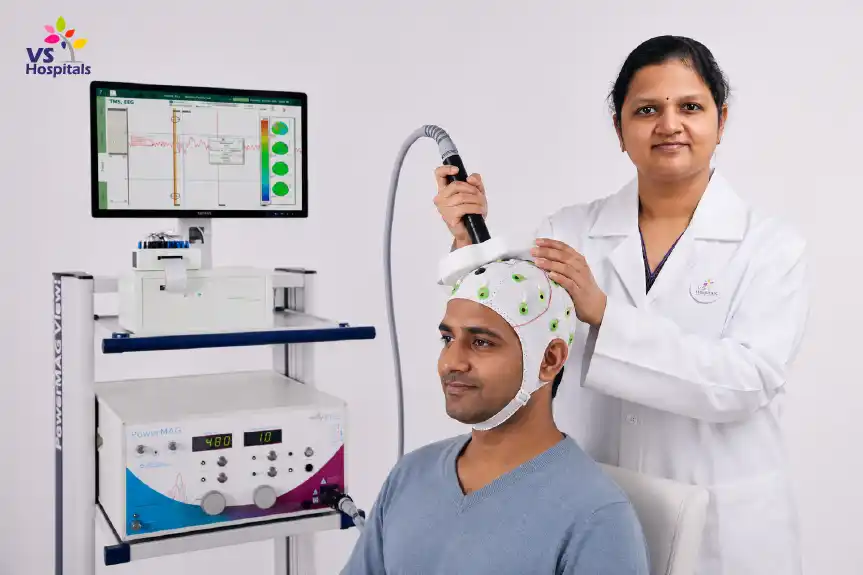
TMS is particularly useful for patients who have not responded adequately to conventional treatments — those for whom standard rehabilitation has reached a plateau. It offers a safe, internationally accepted alternative with minimal side effects, no anaesthesia, and no hospitalisation required. Each session is outpatient, and patients typically notice gradual improvements over the course of treatment.
TMS therapy at VS Hospitals was inaugurated under the leadership of Executive Director Mr. Muthu Subramanian, Group COO Mr. Prassanna, and Senior Consultant Neurologist Dr. L. Sindhuja, marking a milestone in advanced neurological care for Chennai.
As Dr. L. Sindhuja explains: “TMS is a safe, non-invasive procedure that can significantly aid patients struggling with chronic neurological disorders like strokes, which are slow to improve — offering new hope where conventional treatment alone has not been enough.”
Preventing Brain Stroke: 8 Steps You Can Take Today
The most empowering fact about stroke is that most cases are preventable. Here is what you can do right now:
Control your blood pressure Hypertension is the number one modifiable risk factor for stroke. Know your numbers and keep them in check.
Manage diabetes and cholesterol Both damage blood vessels over time and dramatically increase stroke risk.
Eat a brain-healthy diet Prioritise vegetables, fruits, whole grains, and lean proteins. Cut back on salt and processed foods.
Exercise regularly Even 30 minutes of moderate activity five days a week significantly lowers stroke risk.
Quit smoking Smoking doubles your stroke risk. The benefits of quitting begin within hours of your last cigarette.
Limit alcohol Heavy drinking raises blood pressure and increases risk of both ischemic and hemorrhagic stroke.
Maintain a healthy weight Obesity is linked to hypertension, diabetes, and sleep apnea — all stroke risk factors.
Get your stroke risk assessed If you have any risk factors, speak to a neurologist before a crisis occurs. A comprehensive evaluation can identify problems early and prevent disaster.
When to Go to the Hospital — Right Now
If you or someone near you experiences any of the following, call emergency services or head to VS Hospitals immediately:
- Sudden numbness or weakness on one side of the face, arm, or leg
- Sudden slurred speech or inability to speak
- Sudden severe headache unlike any you have had before
- Sudden vision loss or double vision
- Sudden loss of balance or difficulty walking
Do not wait. Do not take a painkiller and rest. Do not drive alone. Every minute matters.
Why VS Hospitals for Stroke Care
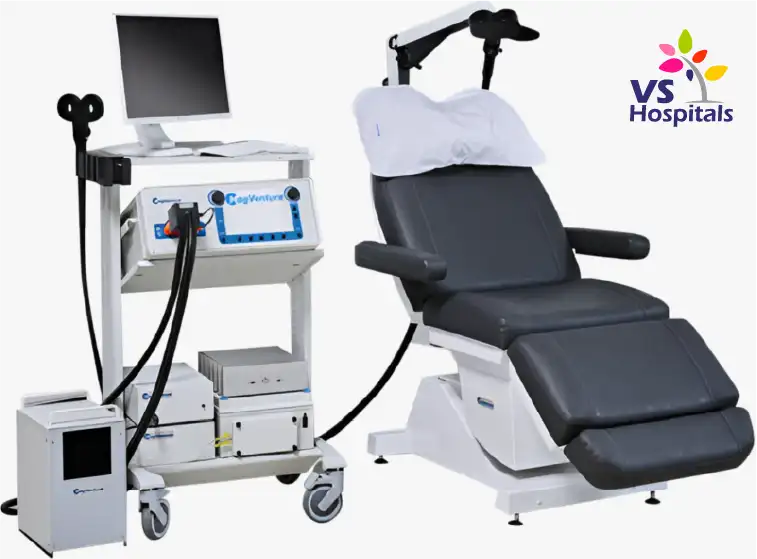
VS Hospitals offers 24/7 emergency stroke care with a dedicated neurology and neurosurgery team, advanced neuroimaging, a fully equipped neuro-interventional cath lab, and now — TMS therapy. Our extended treatment window for mechanical thrombectomy (up to 24 hours in selected patients) means more patients can be reached and helped than at conventional centres.
Whether you need emergency intervention or long-term rehabilitation, our team is with you at every step.
Book a neurology consultation or stroke risk assessment today.
Emergency stroke helpline: +91 95146 98000